Viessmann KOB 300
Pellet boiler · 300 kWt

TèKHNE / PROJECTS / BIOMASS
In Avellino, the redevelopment of the heating plant of a residence for the elderly: from methane to pellets, through the diagnosis of consumption and a new configuration of the system.
THE PROJECT IN SUMMARY
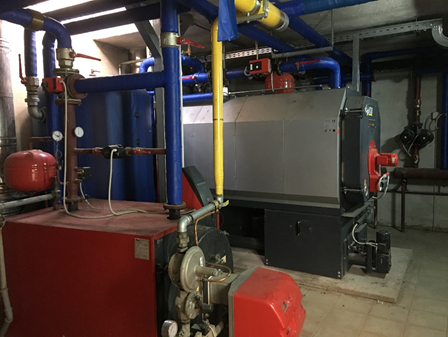
Original photograph of the heating plant after the intervention.
01 / THE CONTEXT
The residence for the elderly housed 56 people in a five-storey building, with an air-conditioned volume of 8,400 m³. Heating and domestic hot water required a reliable heating plant and continuous service.
The analysis of methane invoices and the diagnosis of the building, in actual conditions of use, highlighted an installed power higher than requirements. The project was born from this reading: downsizing the generation and reorganizing the heating plant.
02 / THE INTERVENTION
The sequence of works was built around the continuity of the heating plant.
The 320 kWt generator was put back into operation to power the structure during the works.
Once the 380 kWt boiler was removed, the reinforced concrete base for the new generator was created.
Once the pellet boiler and storage have been installed, the hydraulic circuit has been modified for the new configuration.
The 320 and 80 kWt gas-fired boilers remained available due to maintenance or unavailability of pellets.
03 / THE TECHNICAL SOLUTION
The sizing identified a single 300 kWt pellet generator as the solution for heating and domestic hot water.
The inertial accumulation separates the regulation of the boiler from the immediate request of the circuits: generation is controlled by the temperature of the water in the tank, which feeds the system. The redevelopment thus concerns the architecture of the system, as well as the fuel.
Pellet boiler · 300 kWt
Storage volume · 2,500 litres
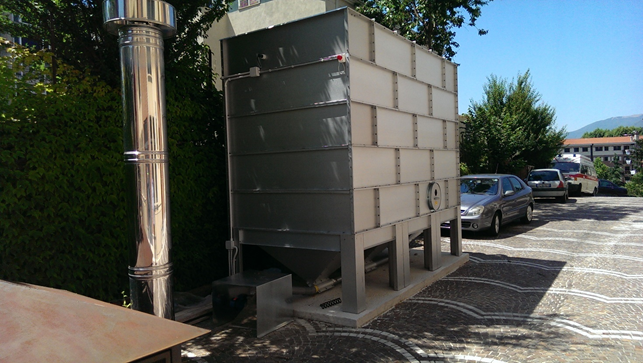
External storage · 17 m³ · up to 11 t of pellets
SYSTEM MANAGEMENT
Procurement, storage and maintenance are part of the solution.
In the case described, the storage was sized for approximately three weeks of average autonomy in the period of maximum use. The supply took place in 1,400 kg big bags, loaded with crane trucks through three loading bays.
The preliminary study considered availability and costs in the area. The deliveries were accompanied by fuel documentation; Class A1 certified pellets were envisaged for the project.
The electronic control of the generator supports the scheduled cleaning and ash removal activities. Maintenance is organized according to the manufacturer's manual and with dedicated assistance for interventions on faults.
The availability of reserve generators completes the strategy adopted to ensure continuity of service to the residence.
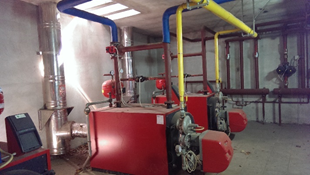
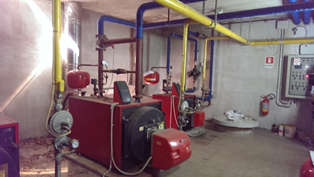
Four original photographs: existing heating plant, new installation and pellet storage. Select a photo to enlarge it.
04 / THE RESULTS OF THE CASE
Final figures for the first two years:
July 2017 – June 2019.
The original case reports a return time shorter than the initial estimate, without government contributions.
The historical reference was an annual methane consumption of 37.967 Sm³, with a cost of 29.312 € for heating and domestic hot water.
The plan considered 75,934 kg of pellets per year. In the two years reported, the actual expenditure for pellets was lower than the cost associated with that expected quantity.
| Operation period | Cost for the expected quantity | Actual expenditure | Deviation reported |
|---|---|---|---|
| 1 July 2017 – 30 June 2018 | approximately €19,742 | 13.426 € | approximately −32% |
| 1 July 2018 – 30 June 2019 | approximately €20,122 | 13.443 € | approximately −33% |
The comparison in the table concerns only the expenditure for pellets compared to the quantity envisaged by the plan, valued for each operating phase. It does not represent the overall management cost nor the percentage saving compared to methane. Historical data of the project, referring to the economic and operational conditions of the period.
THE VALUE OF THE INTERVENTION
The diagnosis, the new generator and the storage worked together: the case shows the role of the design of the entire system in moving from estimates to observed performance.
Source of data and photographs: case of the residence for the elderly published on the TèKHNE website ↗.
FROM PROJECT TO SERVICE
YOUR NEXT INTERVENTION
Let's discuss the characteristics of the structure and the energy objectives.