Building envelope
Facades, openings and construction discontinuities: thermal reading helps to observe non-uniform behaviors, to be evaluated with respect to the structure and conditions of the survey.

TèKHNE / SERVICES
Thermographic surveys and technical interpretation to better understand buildings and systems, identify areas to investigate and guide subsequent checks.
Infrared thermography makes the distribution of surface temperatures visible. It is an investigative tool contactless, useful for observing thermal differences and identifying elements that deserve further investigation.
The value of the survey comes from interpretation: we connect the images to the characteristics of the materials, the environmental conditions and the operating status of the site. Thermography can thus support energy audit, maintenance and evaluation of interventions.
Facades, openings and construction discontinuities: thermal reading helps to observe non-uniform behaviors, to be evaluated with respect to the structure and conditions of the survey.
Pipes, valves and accessible surfaces: the images support the observation of heat distribution and the comparison between elements in the detected operating conditions.
The survey helps to limit the areas of interest and guide further checks. It does not replace the specific tests necessary to confirm the cause of an anomaly.
02 / FROM OUR ACTIVITIES
A selection of thermographic surveys carried out by TèKHNE with a FLIR thermal imaging camera. Select an image to enlarge it.
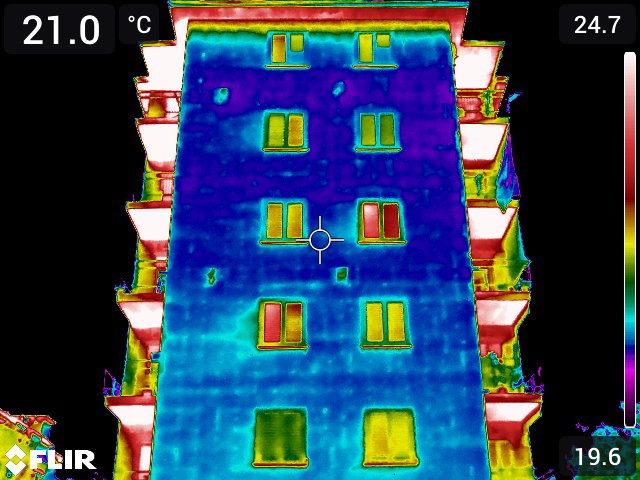
Distribution of surface temperatures on a building elevation.
Survey performed by TèKHNE · FLIR0287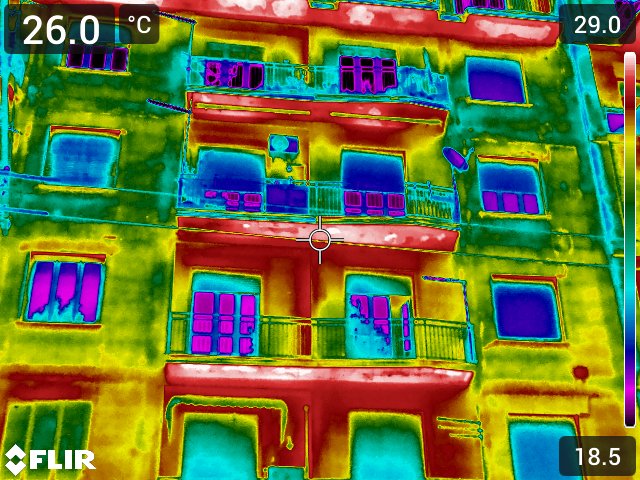
Thermal reading of facade and balcony elements.
Survey performed by TèKHNE · FLIR0662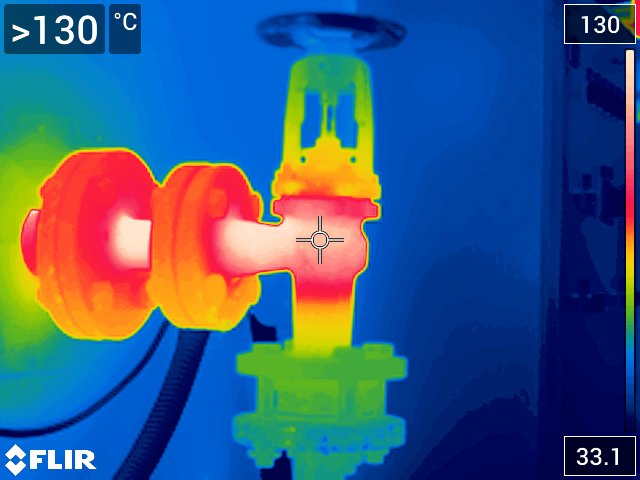
Observation of a component and connections of a system.
Survey performed by TèKHNE · IR_47301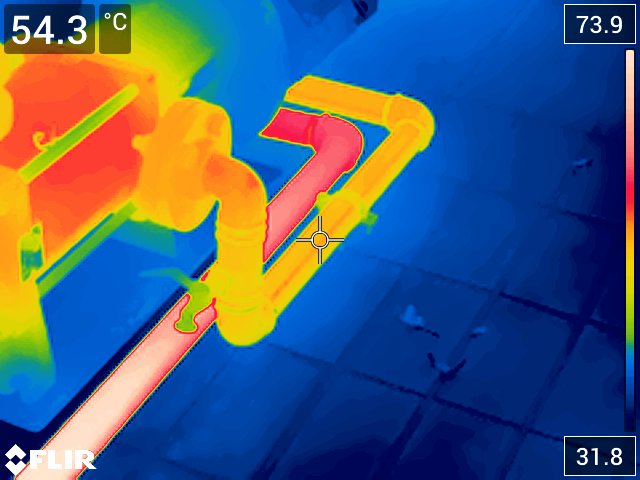
Temperature distribution along a section of pipes.
Survey performed by TèKHNE · IR_47307The colors represent temperature ranges according to the scale shown in each thermogram. Different scales do not allow a direct comparison of colors between images: a lighter or warmer area, alone, does not demonstrate a defect or dispersion.
03 / THE PATH
Objectives and acquisition conditions guide both the inspection and the reading of the images.
We identify elements to examine, technical questions and available documentation. We agree access and operating conditions useful for the investigation.
We collect thermograms and information on site conditions. Materials, reflections, distance, climate and operation of the systems influence the measurement and interpretation.
Let's read the thermal differences with respect to the geometry and use of the elements. We distinguish observations from hypotheses about possible causes.
We organize images, observations and limits of the survey according to the assignment. We indicate useful insights before defining the interventions.
04 / READ THE RESULTS
A thermogram documents an observed condition. To transform it into useful information, technical data and a reading consistent with the objective of the investigation are needed.
Integrate the survey into the diagnosis ↗The thermal imager observes radiation coming from surfaces. It cannot see through walls and the data does not automatically describe what is happening inside the element.
Emissivity, reflected temperature and environmental conditions affect readings. Glossy or reflective surfaces require special attention to distinguish the material response from reflections.
A temperature difference can have different causes. Any leaks, insulation problems or operating anomalies are evaluated with the context and, when necessary, with complementary checks.
TECHNICAL REFERENCES
A reference for the general procedures of infrared thermographic methods applied to buildings. The use must be related to the purpose of the investigation and the characteristics of the case examined.
Consult the UNI reference ↗Emissivity and reflected temperature are essential factors in image reading. Manufacturer documentation helps you understand conditions that affect measurement accuracy.
Learn more on the FLIR website ↗LET'S START FROM YOUR CONTEXT
Tell us about the building or system you want to examine and the question you want to answer.